

What is a Communication Board? A Beginner's Guide to AAC

Updated: Oct 8

Communication is about so much more than talking.
Some people communicate using speech. Others use gestures, facial expressions, sign language, writing, pictures, technology, or a combination of different methods.
A communication board is one simple, powerful way to support people who have difficulty communicating through speech alone.
In this guide, we'll look at what communication boards are, who can use them, how they support AAC, and how you can begin using them in everyday activities.
Jump to a Section
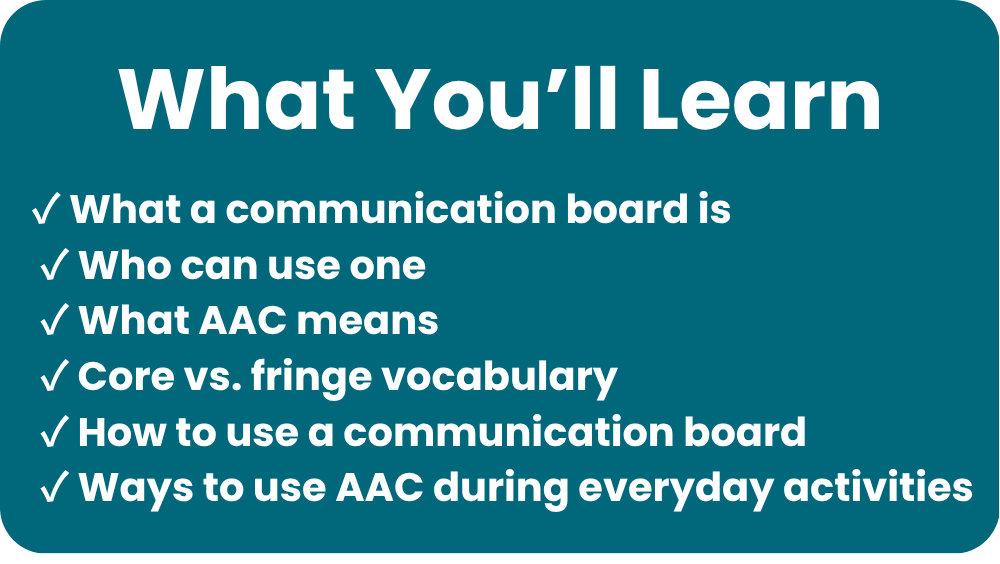
What is a Communication Board?
A communication board is a type of augmentative and alternative communication (AAC) that uses pictures, symbols, words, letters, or a combination of these to help someone communicate.
Instead of relying only on speech, a person can point to, touch, look at, or otherwise indicate the words or symbols they want to use.
Communication boards can be very simple, with just a few choices, or they can contain a much larger vocabulary that allows a person to create many different messages.
They can be printed, laminated, placed on a desk or wall, carried in a bag, or kept nearby so they are available when communication is needed.


Communication boards are sometimes described as low-tech AAC because they don't require batteries, an internet connection, or an electronic device.
But "low-tech" doesn't mean "less important."
For many people, a printed communication board can be an essential communication tool. It can also work alongside speech, sign language, gestures, or a high-tech AAC system.
Who Can Use a Communication Board?
Communication boards can be useful for people of many ages and with many different communication needs.
They may be used by children, teens, and adults who have difficulty communicating through speech alone—or by people who simply benefit from having an additional way to communicate.
Communication boards may support people who:

A communication board isn't only for one diagnosis or one age group. The type of board, vocabulary, number of symbols, and way it is accessed should be matched to the individual person.
For some people, AAC may be their primary way of communicating. For others, a communication board may supplement speech or provide additional support in certain situations.
The goal is not to make everyone communicate in the same way.
The goal is to provide meaningful ways for each person to communicate.

What Does AAC Stand For?
AAC stands for Augmentative and Alternative Communication.
It is a broad term for the many ways people can communicate when speech alone isn't enough.
AAC can include everything from simple picture boards and communication books to speech-generating devices and other electronic communication systems.

What does "augmentative" mean?
"Augmentative" means adding to communication that already exists.
For example, someone might use spoken words but also use a communication board when they need additional support expressing themselves.
AAC doesn't have to replace speech. It can be used alongside speech, gestures, facial expressions, signs, or other ways of communicating.
What does "alternative" mean?
"Alternative" means providing another way to communicate when speech isn't available, effective, or preferred.
A person may communicate using pictures, symbols, writing, signs, an electronic AAC system, or another method instead of relying on speech.

Want to learn more about AAC?
The American Speech-Language-Hearing Association (ASHA) provides additional information about augmentative and alternative communication.
What Can You Say With a Communication Board?
A communication board can do much more than help someone ask for something.
Communication includes requesting, rejecting, commenting, answering questions, expressing feelings, greeting others, taking turns, and sharing ideas.
When a communication board includes a variety of meaningful words and messages, it can give a person more ways to participate in conversations and everyday activities.
Communication Is More Than Requesting

Imagine a student using a communication board to say "I don't like it," "Look at that!" or "My turn!"
These messages help the person share opinions, connect with others, and take an active role in what is happening around them.
Communication boards should offer opportunities for people to express their own thoughts and preferences—not just answer questions or request items.

What Is the Difference Between Core and Fringe Vocabulary?
When exploring communication boards, you may come across the terms core vocabulary and fringe vocabulary.
These terms describe two broad groups of words that can help people communicate.
Understanding the difference can make it easier to choose a communication board that supports a person's everyday communication needs.

Core and fringe vocabulary can work together to give someone a wider range of communication options.
For example, a person might use the core words "WANT" and "MORE" alongside a fringe word such as "BUBBLES" to communicate "Want more bubbles."
The core words provide flexible language, while the fringe word adds specific information.
Both types of vocabulary can be valuable when choosing or creating a communication board.

A communication board doesn't need to include every possible word to be useful.
The important thing is to consider whether the vocabulary gives the person meaningful opportunities to communicate across different activities and situations.
What Are the Different Types of Communication Boards?
Communication boards come in many different shapes, sizes, and layouts.
Some contain just a few pictures or words, while others include a larger vocabulary that allows someone to communicate a wide range of messages.
Boards may use pictures, symbols, written words, or a combination of these.
The best format depends on the person's communication needs, preferences, and how they access the board.

These examples show just a few of the many ways communication boards can be designed.
Some boards focus on a specific activity, while others provide vocabulary that can be used throughout the day.
A person may benefit from using more than one board, depending on the situation. For example, a core vocabulary board might be available throughout the day, while a topic-specific board provides additional words during a particular activity.


How Do You Use a Communication Board?
Using a communication board is about creating opportunities for someone to communicate throughout the day.
A person may point to a picture, touch a word, look toward a symbol, or use another reliable way to indicate a message.
You don't need to wait for a formal lesson or a therapy session. Everyday activities can provide meaningful opportunities to communicate.
Here are some simple ways to get started.

Example: Using a Communication Board During Play
Imagine you're playing with toy cars together.
You can model words such as GO, STOP, MORE, FAST, and HELP on the communication board as you play.
You might say:
"Ready, set, GO!"
"Let's STOP."
"Do you want MORE?"
"That car is FAST!"
Pause occasionally to give the person an opportunity to communicate.
They might use the board to request another turn, comment on the activity, reject something, or share an idea.
The goal is to make communication part of the activity—not to turn play into a test.

Watch: Using a Communication Board During Play
Want to see how a communication board can be incorporated into a hands-on activity?
In this video, I'll show you how to use a communication board during play with play dough.

How Can Communication Boards Support Autistic People?
Autistic people communicate in many different ways. Some use spoken language, some communicate without speech, and others use a combination of communication methods.
A communication board can provide an additional way to express thoughts, make choices, share feelings, and participate in everyday activities.
For some autistic people, a communication board may be a primary communication tool. For others, it may supplement speech or provide support in particular situations.
The most important consideration is finding communication tools that respect the person's individual needs, preferences, and communication style.

Communication boards can be incorporated into everyday routines, activities, and interactions.
Some people may benefit from having a board available throughout the day, while others may use different boards for specific activities or situations.
A person's communication needs may also change over time, so it can be helpful to review whether the vocabulary and format continue to meet their needs.
The goal is to support communication—not to require everyone to communicate in the same way.
Watch: Using a Communication Board During Play
Communication boards can be incorporated into playful, hands-on activities to create opportunities for interaction and communication.
In this video, I'll demonstrate how to use a communication board during play with potato toys.

Where Can You Use a Communication Board?
Communication boards can be used in many different environments throughout the day.
They can support communication at home, in classrooms, during speech therapy, and out in the community.
Having communication tools available in different settings can create more opportunities for people to express themselves, interact with others, and participate in everyday activities.

A communication board that works well in one setting may not include everything a person needs in another.
For example, a classroom board might include words for learning activities, while a board used at a restaurant might include vocabulary for ordering food, expressing preferences, and interacting with others.
Some people benefit from having a familiar communication board available across multiple settings, with additional vocabulary added when needed.
The goal is to make communication accessible wherever it happens.

How Do You Choose the Right Communication Board?
Choosing a communication board involves more than finding one with appealing pictures or familiar words.
The board should support the person's communication needs, interests, and ability to access the vocabulary.
Some people may benefit from a simple board with a small number of choices, while others may need a larger vocabulary that supports a wider range of messages.
Here are a few things to consider when choosing a communication board.
5 Things to Consider When Choosing a Communication Board
📝 1. Vocabulary
Does the board include words the person can use to express a variety of messages—not just request items?
Consider including words for:
Requesting
Rejecting
Commenting
Expressing feelings
Social interaction
👆 2. Accessibility
Can the person access the board in a way that works for them?
Consider:
Pointing or touching
Eye gaze
Partner-assisted scanning
Other individualized access methods
🎨 3. Visual Design
Is the board visually clear and easy for the person to navigate?
Consider:
Picture or symbol size
Spacing between symbols
Contrast and readability
The person's visual preferences
🏡 4. Everyday Use
Will the board be available when the person needs it?
Consider:
Where it will be used
Whether it is portable
Whether it can be placed within reach
Whether additional boards may be useful in other settings
💛 5. Individual Preferences
Does the board reflect the person's interests, communication style, and preferences?
Consider:
Familiar vocabulary
Meaningful activities
Preferred symbols or pictures
Opportunities to express personal choices
There is no single communication board that works for everyone.
The most useful board is one that gives the person meaningful ways to communicate and can be accessed in their everyday environments.
When possible, involve the person in choosing vocabulary, symbols, and formats. Their preferences and communication needs should guide the process.

Where Can You Find Printable Communication Boards?
Once you know what you're looking for, finding a communication board is the next step.
Printable communication boards can be a convenient option because they can be printed, prepared, and kept where communication is needed.
When looking for a printable board, consider whether the vocabulary, symbols, layout, and format are appropriate for the person who will be using it.
It's also helpful to think about where the board will be used and whether you need a general communication board, a core vocabulary board, or a board designed for a specific activity or situation.
Looking for Communication Boards to Get Started?

I created my communication boards with the goal of giving learners meaningful ways to communicate, participate, and show what they know.
You'll find communication boards designed for different communication needs, activities, and situations—including core vocabulary and topic-specific options.
Explore the All Hands On Language communication board collection to find a board that fits your needs.
Want to See Communication Boards in Action?
Seeing a communication board used during an activity can make it easier to understand how it fits naturally into everyday communication.
I share practical demonstrations on my YouTube channel showing ways to incorporate communication boards and visual supports into hands-on activities.
Watch the All Hands On Language YouTube channel for communication ideas and demonstrations.

Final Thoughts: Communication Is More Than Talking
A communication board can be a simple tool, but it can make a meaningful difference in how someone participates in everyday life.
Whether a person communicates primarily through AAC, uses a communication board alongside speech, or benefits from visual communication support in certain situations, having accessible ways to express thoughts and ideas matters.
Communication isn't just about requesting what we want. It's about saying yes and no, sharing an opinion, expressing a feeling, asking a question, making a joke, connecting with another person, and having a voice in what happens around us.
The right communication board can help create more opportunities for all of these things.
Every person deserves meaningful ways to communicate.

Ready to Put Your Communication Board Into Practice?
Now that you understand what communication boards are and how they support AAC, the next step is learning how to use one during everyday activities.
Explore my guide, How to Use a Communication Board: 7 Simple AAC Strategies for Everyday Activities, for practical tips on modeling language, encouraging meaningful communication, and making AAC a natural part of daily routines.
Frequently Asked Questions About Communication Boards
FAQ 1 What is a communication board?
A communication board is an AAC tool that uses pictures, symbols, words, letters, or a combination of these to support communication. A person may point to, touch, look at, or otherwise indicate the symbols or words they want to communicate.
FAQ 2 Who can use a communication board?
Communication boards can be used by children, teens, and adults who benefit from additional support for communication. They may be useful for people who are non-speaking or minimally speaking, autistic people, people with language or communication difficulties, or anyone who benefits from having another way to communicate.
FAQ 3 Are communication boards only for non-speaking people?
No. A person does not have to be completely non-speaking to benefit from AAC. Someone who uses speech may also use a communication board to supplement their communication, particularly during activities or situations where additional support is helpful.
FAQ 4 What is the difference between a communication board and AAC?
AAC, or augmentative and alternative communication, is the broader term for different ways of supporting communication when speech alone isn't enough. A communication board is one type of AAC. AAC can also include communication books, picture symbols, sign language, writing, and speech-generating devices.
FAQ 5 Can I use a printable communication board at home or school?
Yes. Printable communication boards can be used in many everyday settings, including home, school, therapy, and community activities. Choose a board with vocabulary and a format that are appropriate for the person who will be using it, and keep it accessible during activities when communication is needed.

Comments